When I saw that Tiger Woods’ former caddie, Steve Williams, was putting out a book about their partnership on the golf course I ordered it right away. Together We Roared was a good read and I was pleased to see they didn’t give much attention to Tiger’s off the course troubles during those years. The focus was on the golf and the relationship between player and caddie. Williams provided a lot of insight and stories that have never been told and he even opened up his house to his co-author, showing some of his Tiger memorabilia.
This book is great for any golfer, especially a Tiger fan.
When I saw Jon Sherman had written a follow up to “The Four Foundations of Golf” I immediately ordered a copy (get yours on Amazon). I try to read that book every year, so I was excited to take a deeper dive in to some of the aspects of competitive golf. While I haven’t played any tournaments in years, I’d like to get back in to it and I do complete all summer with our golf group
If you haven’t read Jon’s first book, I think you would get much more out of it first. Then absorb his second book. One of the key focuses in “Winning Golf” is how tournament/competitive golf is such a different beast than recreational, mainly due to the pressures.
Two things I’ll adapt for next year:
Set principals (or goals) related to the mental aspects of the game. Such as staying positive (or returning focus to it when thoughts drift negative) or how I’d prefer to react to different situations on the course.
After each round, review not only how I played, but also how well I did with my principals. Look for patterns in play as well as mental.
I won’t reread this book often but can see myself coming back to some sections. Check out the books and follow @practicalgolf on X/Twitter, where he shares a lot of great stuff from “The Four Foundations.”
This book was a much slower and tougher read than The Four Foundations of Golf. The majority of the book focuses on how we learn and theories. I kept getting tempted to skip some of these chapters to get to the good stuff. I pressed on, hoping all of the pieces would fit together and make the read worth it.
Unfortunately a lot of the practice ideas felt much more suited to practice time on a simulator where you can measure distances and accuracy. Those are very difficult to measure on a driving range. Having a sim at home would also make it much easier to have short practice sessions of 15-30 minutes. In order to do that at the driving range requires well over an hour to pack up the vehicle, drive to the course, get range balls, loosen up, practice, and drive home.
On page 365 of 385 I was surprised to read the following.
…this book is aimed at aspiring tour players, as well as coaches who are teaching players who spend their lives on the practice rounds.
Quite different from the back cover stating, “The book everyone has been waiting for” and “If you love golf, you will love this book.”
As I read more and more of the book, I got the feeling it was not written for typical amateurs. Had I known this, I wouldn’t have bought it. I do not recommend reading it. The information I found most useful in the book was presented in The Four Foundations of Golf, which I believe would benefit every amateur golfer.
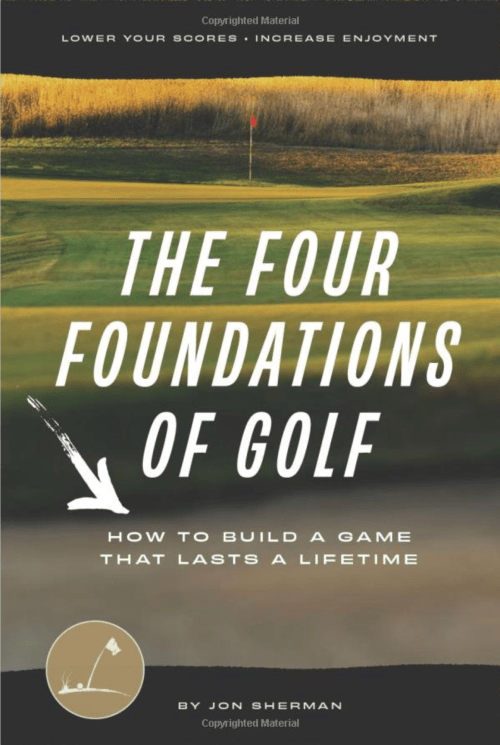
Last summer I blazed through my first read of The Four Foundations of Golf by Jon Sherman and loved it. I just finished my second reading and will likely read it once or twice a year. The information is so good.
Jon has been golfing for decades and does a wonderful job presenting everything in an easy to read format. He runs the Practical Golf site, where a lot of the same information is presented in different ways. His Twitter account is a great follow as well.
A big part of the book focuses on strategy, which many of us get wrong. Here’s a taste…
Last year I started using the Golfshot GPS and scoring app on an Apple watch for the first time. I switched from using a range finder to zap the pin on each hole to using middle and back of the green distances, which I get from a watch. It’s really changing my game. After reading Four Foundations I realized I needed more stats to help me determine where I could improve the most. I bought the new Shot Scope X5 watch, which provides all of the strokes gained data I need. I’m looking forward to putting in more practice time this year to see where I can take my handicap.
It’s probably not a coincidence that Jon and Adam have a podcast together, called The Sweet Spot, which you can find on all of the podcasting platforms. I’ve started reading Adam’s book, The Practice Manual: The Ultimate Guide for Golfers and am learning a lot more about the physics of golf and how to use that information to determine what is happening when I hit the ball. You can bet I’ll post a review when I’m finished with the book.
“The Four Foundations of Golf” is a must read for every golfer.
I’ve been wanting to learn about strokes gained because it’s everywhere in golf now. What better source than a book written by the man who created strokes gained? “Every Shot Counts” by Mark Broadie.
So what is strokes gained?
Strokes gained is a way of analysing a player’s performance level when comparing every aspect of their performance with other players within a particular dataset. It measures the golfer’s performance taking into account, the hole length, shot length, lie type of every shot and putt during a round of golf.
The PGA Tour has really embraced SG, replacing many of the traditional golf stats for the most part. It’s a great way to measure the golf game and now there are products like Arccos and Shot Scope available to amateurs like me who want to analyze their own game to determine weaknesses and improve their handicap. I bought the new X5 watch from Shot Scope and will post about it after I’ve played more rounds with it.
There were parts of the book that seemed to repeat over and over again, but I realize stats and math can be hard for people to understand, so I think Mark was trying to drive home the concepts. The book was released in 2014, so I really enjoyed all of the references to Tiger Woods domination. SG shows how much better he was than everyone else who teed it up.
Overall it’s a really great book on the topic. You get in depth information about SG, the different categories, and plenty of examples from the PGA Tour. Perhaps the most valuable part of the book is the strategy information near the end. By using the math, Mark teaches the reader how to use SG to determine optimal decisions on the golf course.
With the data I’ve started collecting and some other things I’m reading, I’m excited to see where I can take my game this year. Stay tuned!
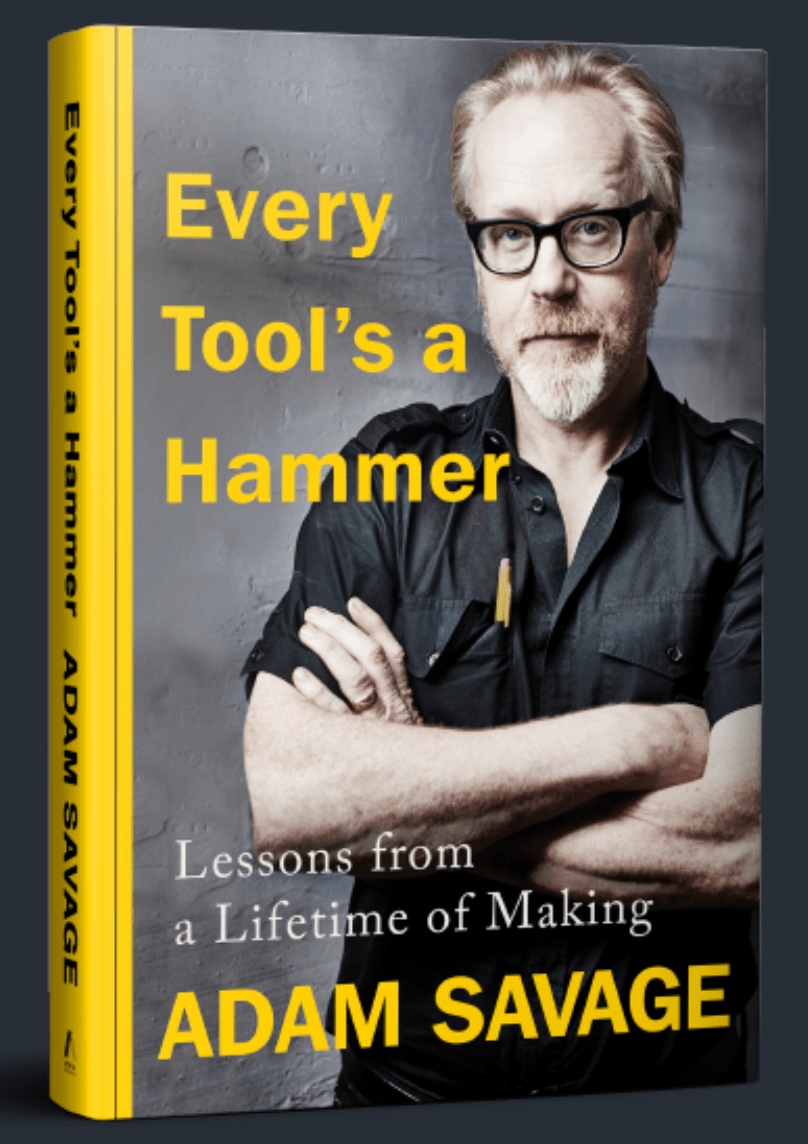
I’m a big fan of Adam Savage and Tested, so when I saw he was writing a book, I preordered it from Amazon.
That was four years ago. I’m embarrassed to say the book had been untouched on my Kindle since it was released in May of 2019. I finally turned the page on the flights to Madrid and easily finished it.
Putting something in the world that didn’t exist before is the broadest definition of making, which means all of us can be makers. Creators.
Everyone has something valuable to contribute. It is that simple. It is not, however, that easy. For, as the things we make give us power and insight, at the same time they also render us vulnerable. Our obsessions can teach us about who we are, and who we want to be, but they can also expose us. They can expose our weirdness and our insecurities, our ignorances and our deficiencies.
If you’re a creative of any type I highly recommend reading Adam’s book. I learned a lot and it felt good to know other people think the way I do about a lot of things.
One of the chapters focused on lists, which is something I use often. Usually I prefer Apple Notes because is syncs between my iPhone and MacBooks (work and personal), allowing me to quickly update the lists. Here’s a list I started partway through my bathroom remodel.
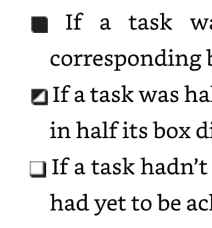
Adam writes out his lists and makes a checkbox next to each item. When something is halfway or mostly complete he splits the box diagonally and fills in the upper left area. On completion, the entire box is filled in. It’s such an important process for him that after the Lists chapter was another titled Checkboxes!
Whenever I put a list to paper I’m going to try this method.
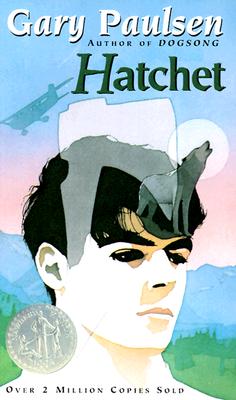
Whenever I think back to growing up, the book that comes to mind is Hatchet by Gary Paulsen. I don’t really remember much about the story, other than the kid was stuck out in the woods by himself and survived because he had a hatchet.
I always thought the survival aspect of the story was so cool. I think that is part of why I enjoy movies, stories, and shows with similar aspects, like Alaskan Bush People or Alaska: The Last Frontier. Sure, these shows are produced and played up a bit, but you still get to see people out in remote areas surviving on a lot less than we have here.
I’ll bet it has also shaped some of how I like to repurpose things or make things on my own. It can all lead back in some part to this book I read as a boy. I still remember trips out to the woods with my dad to scout deer and how much I enjoyed taking his hatchet with us to cut branches or small trees. I think I need to buy myself an old hatchet when I see one at an estate sale!
I bought this book when it came out in 2013 and until a few months ago it had been untouched on my Kindle. It’s hard to believe it was over 4 years ago and Tiger’s crash (pun intended) was even earlier. I wish I hadn’t waited so long to read it.
I’d been a Tiger Woods fan since his historic 1997 win at the Masters. In fact, I almost never watch a golf tournament unless he is playing. The excitement just isn’t there for me unless he’s in contention, which was pretty much every tournament he played for over a decade.
Through the book, Hank Haney gives us a lot of insight into Tiger’s personality. Many things make a lot more sense. At the same time, the book is one man’s view of Tiger. No matter what I read, at the end of the day, I’m still a fan of Tiger Woods the golfer.
If you’re a golf fan or even just a sports fan, I recommend reading this book. You’ll get a rare look into what it’s like working with one of the greatest professional athletes in history.
As shown throughout the pages, he wasn’t always easy to work for, live with, or be around, and you definitely didn’t want to piss him off. We’ll never understand what he was really like by reading stories in a book, but it does help to explain a side of Jobs we wouldn’t know existed since most of us only ever saw him during Apple events.
You can’t have a biography about Steve Jobs without a major focus being on Apple and the products he brought to market. It was neat to read how many of these devices got started, were developed, and eventually launched.
Steve Jobs was a genius and a visionary who changed our world. He is the definition of Think Different, which was later adapted in a tribute about him…


 I’ve been wanting to learn about strokes gained because it’s everywhere in golf now. What better source than a book written by the man who created strokes gained? “Every Shot Counts” by Mark Broadie.


 Whenever I think back to growing up, the book that comes to mind is

 Nick Momrik