Boldport: PissOff

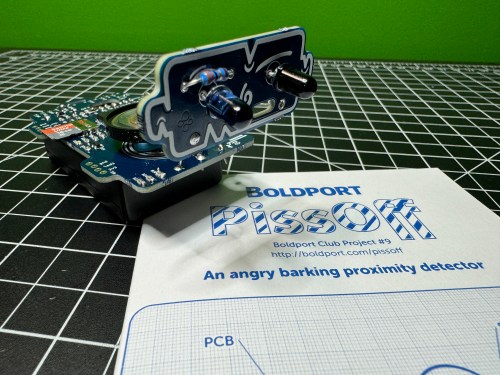
PissOff was project #9 of the Boldport Club, which was before my membership, but I bought it in December of 2018 with my credits when the club closed. I recorded an unboxing video on February 21, 2021 and I guess I ran out of time for the build. The project sat on my shelf for almost three more years before I finally assembled the circuit, which ended up being five years after ordering it!

The kit created a proximity sensor via IR and combined it with annoying noises. With so many surface mount components, this was one of my most challenging electronic soldering builds. I really struggle when an IC has a lot of pins. At one point I tried some other solder and realized what I’d been using was junk, so it went right in the trash.

I screwed up the placement of a couple of SMD capacitors, but caught myself soon enough to remember which ones needed to be exchanged. The other mistake I made was swapping locations between the IR phototransistor and diode, which I didn’t catch until testing. After putting them in the correct locations, everything worked!
Here’s a 8x speed run of the unboxing and some footage of Ninja’s testing.

Useful links:

RasP.iO Breadboard Pi Bridge

The Breadboard Pi Bridge is a neat way to connect the Raspberry Pi to a breadboard for prototyping. I preordered this kit in March of 2019 from RasP.iO after I’d seen Alex Eames release some cool kits there before. It shipped less than two months later, but it took me until February of 2021 to assemble it. Then it sat on the shelf until now when I finally did the testing and put together the video.

The build was simple with only having to solder some headers to a circuit board. I look forward to using this when I make some projects based on Pis.

Boldport: Pease-out

Pease-out was project #32 of the Boldport Club. This kit is kind of boring one, since it’s main purpose is a tribute to Bob Pease, an expert analogue designer. Adjustments to the potentiometer change the output frequency of the LM331, which can be observed by the flashing LED.

It was a simple build and removes another project from my todo list.

Boldport: Juice (FAIL)

I started this build a couple of weeks ago and “finished” it today. It is supposed to be a battery replacement kit for use in prototyping if you run out of batteries. It was project #12 in the Boldport Club.

Mine, did not turn out to be a useable device, because I shorted the connections in the USB connector, which I put on last and should have done first. If there’s one complaint about the Boldport Club kits it’s that the instructions are lacking. I messed around with different desoldering techniques to try and correct the problem, but I might have been fighting a losing battle depending on how deep in there the shorted connections were. I figured something was screwy when the LED never lit up. Then when I connected a 9V battery as the power source instead of USB I knew something was really wrong. With a multimeter I was only getting millivolt readings from the board. I felt the battery and it was really hot, so I disconnected to read the battery it was down to less than 9 volts already, when it had started close to 9.5! That’s when I called it quits.

I’m almost positive I thought this kit was something else when I ordered it with credits I had. I can’t see myself using this during a project if it had been a success, so I’m not too disappointed. Even though it was a failure I figured I’d still post the video. Since it was just over five minutes long at 20x speed with all of the footage I didn’t even bother to do any editing. The camera had filled up somewhere during the desoldering complications and I was too frustrated to bother with getting a new SD card. Enjoy! Or not.

Boldport: LIGEMDIO

A couple of weeks ago I assembled one of the BoldPort Club kits I had piled on my desk. This one was project #8, titled LIGEMDIO. It’s an LED tester and the name comes from the first letters of Light Emitting Diode, LED.

It was a cool little build after I swapped out to an old soldering iron and it’s a project I’ll actually get some use out of. Would have been nice to have when I tested all of the LEDs for the 8x8x8 cube.

AdaBox 012: PyGamer

I recently got the 12th AdaBox.

It’s a cool open source gaming platform, the Adafruit PyGamer, which can be used with CircuitPython, MakeCode Arcade, or Arduino games. I remember getting a GameBoy and staying up late to beat various levels of Super Mario Land when I had a sleepover at a friend’s house. I may have to try making my own game for this device.


Boldport: Capaci-meter (#31)

This is the penultimate project from Boldport Club before they move away from the subscription model. It is called Capaci-meter and is project #31. I’m really sad to see the Club changing because I’ve enjoyed the projects a lot more than any of the other electronics kits and the PCBs are so beautiful. It’ll be interesting to see where it goes.

After having issues with my Hakko FX-888D soldering iron, I finally did some troubleshooting and by using a meat thermometer I determined the tips weren’t getting hot enough. Then I found the device actually has an adjustment mode which lets it compensate. Works great now and is so much better than that cheap iron I’ve been using for other recent projects.

It’s great when the project produces a useful device like this for testing the value of capacitors.

AdaBoxes 8 & 10

More catching up on electronics stuff that was piled on my desk. Here I unboxed AdaBoxes 8 and 10. Then I assembled 10, which is a sweet device, and loaded some of the code examples. Skip ahead to 17:23 if you only want to check out the demos.

In the past I mentioned I might cancel my AdaBox subscription, which I did after box #8. On social media and in their YouTube shows Adafruit has been pretty much telling you what’s in the next box, which has been nice. I knew #9, based on their HalloWing board, didn’t interest me. Then when I realized #10 was going to be the NeoTrellis and subscriptions were still open late in the quarter I jumped in. I plan to make a game-time decision each quarter from here on out.

Unboxing HackerBox #0030: Lightforms

Quick unboxing video for the latest HackerBox.

Official box contents from the Instructable:

  • HackerBoxes #0030 Collectable Reference Card
  • NodeMCU V3 Module with ESP8266 and 32M Flash
  • Reel of 60 WS2812B RGB LEDs 2 meters
  • 8x8x8 LED Kit with 8051-Based MCU and 512 LEDs
    • PCB
    • Reusable Plastic Parts Box
    • Two 4.7 KOhm Resistors
    • Eight 470 Ohm Resistors
    • 10 KOhm Eight Resistor Array
    • STC12C5A60S2
    • 40-Pin DIP Socket
    • Eight 74HC573 Octal Latches
    • Eight 20-Pin DIP Sockets
    • ULN2803 Transistor Array
    • 18-Pin DIP Socket
    • Two 10uF 25V Electrolytic Capacitors
    • Two 22pF Ceramics Capacitors
    • 12MHz Crystal Oscillator
    • Barrel Power Socket
    • 4-Pin Serial Header
    • Power Switch
    • Cable with USB to 5V Barrel
    • Red Hookup Wire
    • 550 LEDs
  • USB Serial Module with CH340G and Jumper Wires
  • Stranded Hookup Wire 3 meters, 22 gauge
  • Exclusive HackerBoxes Decal
  • Exclusive Dark Side LED Decal

It’s disappointing that HackerBoxes resold us a popular kit that you can get for $15-20. I’ve seen these LED cubes many times online and while they do look awesome, I never bought one because I didn’t think I’d have the patience to put one together. I guess I’ll get the chance now.

I’ll probably try to do a time-lapse of this assembly, which is going to take a long time.