So when part 3 of this series turned out to be a bit uneventful, I wasn’t expecting a grand finale with fireworks. I was right about it being more difficult though.
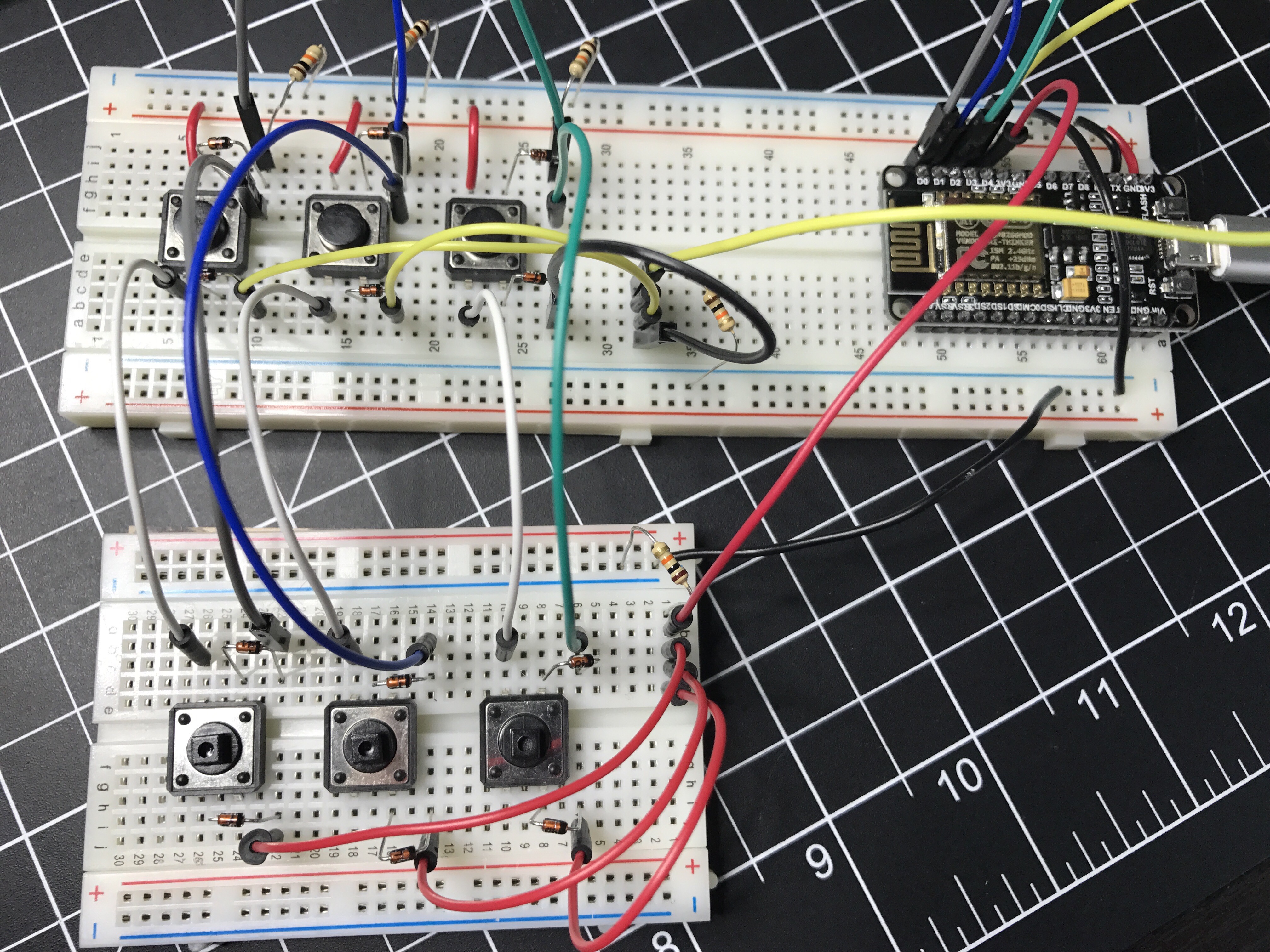
Through numerous failed attempts I was running into trouble isolating the signals between the rows and columns. Everything was getting connected in one big circuit. Then I realized it was a perfect place to use diodes! Each button needed 2 though; one for its connection to the row and one to the column. I have a bunch of 1N4148 signal diodes so I wired everything up.
Although the Fritzing is using a different board than in the implementation pictured above, it’s much easier to follow the wiring…
This obviously is a lot more complicated circuit than the examples in part 3 of this series. It was a success at what I set out to do though and it works great with my custom keypad code. I’ve also added the actual Fritzing file for this circuit to the repo.
I’m glad I continued down this path with keypad experimentation. I learned a lot. In the beginning I was wondering why the keypads you can buy these days work the way they do and not how I had wired up the old phone keypad to function. Turns out what ended up being a simple solution for me was due to how the old phone keypad made its connections mechanically inside the device. The keypad solutions I showed in part 3 are much easier to create as I’ve now proven by recreating the circuit above.
I’m still curious if I could wire up the old phone keypad to work with the Arduino Keypad library. I guess if I ever get my hands on another old phone, I’ll have to continue with a part 5 of this series.
The HackerBoxes look lower quality, but are cheaper ($44 compared to $60, both with free shipping) and ship monthly instead of quarterly. The previous boxes listed on the site looked neat and sell for $59 before shipping so it seemed like a pretty good deal. I really like the idea of having something new to tinker with each month instead of only 4 times a year. I signed up and was surprised to get a shipment notification for the most recent box.
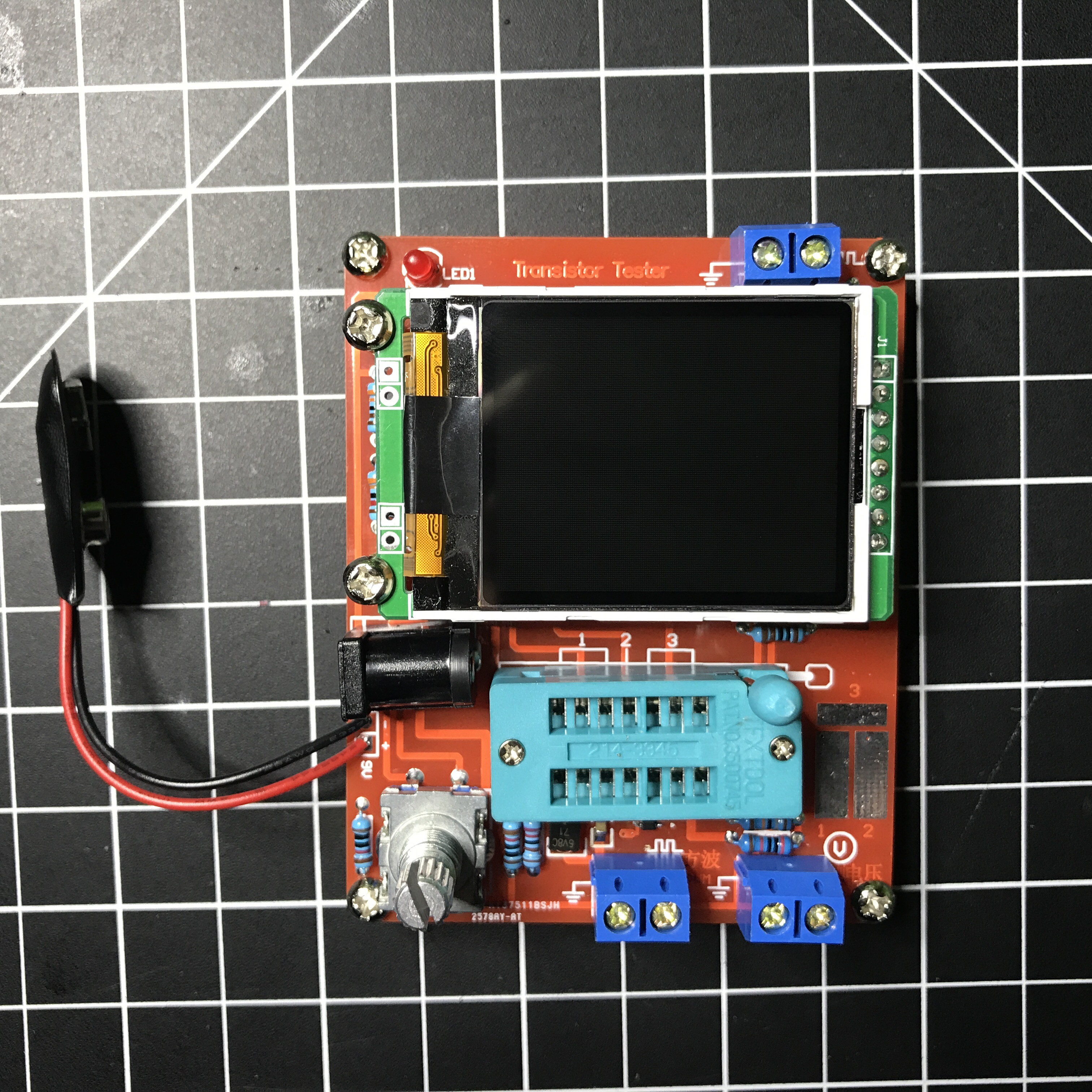
This box is based around a little Transistor Tester kit you build. It also comes with a variety of extra electronic components that help go through a series of tutorials and aid in experimenting with circuits and the tester. If this box is any indication, I’m going to enjoy these each month.
It took me a couple of hours to assemble and solder the tester kit. I recorded it (had to stop twice to recharge the GoPro battery) and ended up with over 100 minutes of video! Nobody wants to watch all of that, so I cut out some empty space and sped it up to 20x.
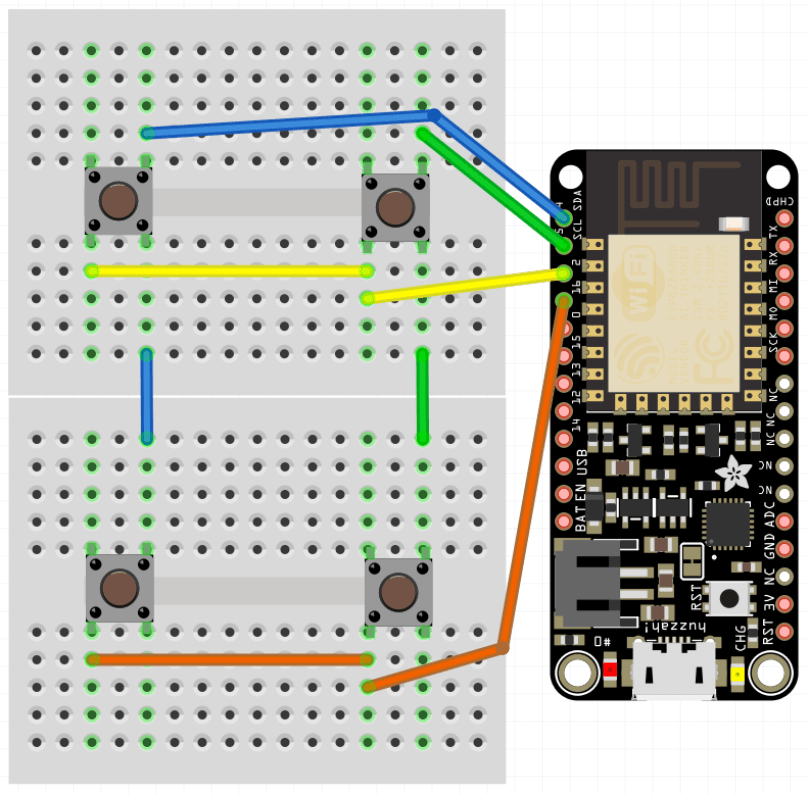
In parts 1 and 2, I walked through my journey of repurposing the keypad out of a phone from 1980. I learned that a more modern keypad matrix doesn’t exactly function (behind the scenes) in a way I’d expect. I wanted to understand it better so I set out to recreate a 2×2 keypad (kept it simple to make wiring easier) that would function the same way as something you can buy today. It would be a success if it worked with the Arduino Keypad Library.
From my earlier looks through the code I knew it pulsed power out to a column pin and then read in each row’s key from that column before switching to the next column and repeating the process. I figured that should be enough for me to wire this up and try example programs without going back to look at the library’s code again.
I don’t know why I was thinking this would be more complicated and at least a little more exciting, but it was unbelievably easy. I guess I should be celebrating I understood how it worked. Literally all you do is connect one side of every button in a column to a pin and one side of every button in a row to a pin. No need for connections to power, or ground. No pull up/down resistors.
It immediately worked with the Arduino Keypad library examples, even the MultiKey one. I guess being able to detect multiple key presses at once is where the advantage to this implementation comes in. It worked flawlessly when pressing 2 of the 4 buttons, but when you get to 3/4 there are too many connections to distinguish the keys.
Just to be sure I had it figured out, I added a 3rd column to make it a 2×3 grid and it was just as easy.
I love the beauty of how simple this is. I’ve added Fritzing for both of these to my phone-keypad GitHub repo (2×2 & 2×3). If you check this PDF, in the How it Works section it has a really good explanation and shows the row and column connections exactly like I came up with.
Naturally now I need to do a part 4 and attempt to recreate the keypad implementation I ended up with from the old phone. Due to how it mechanically makes the electrical connections I think it’s going to be a bit more complicated than this was. We shall see…
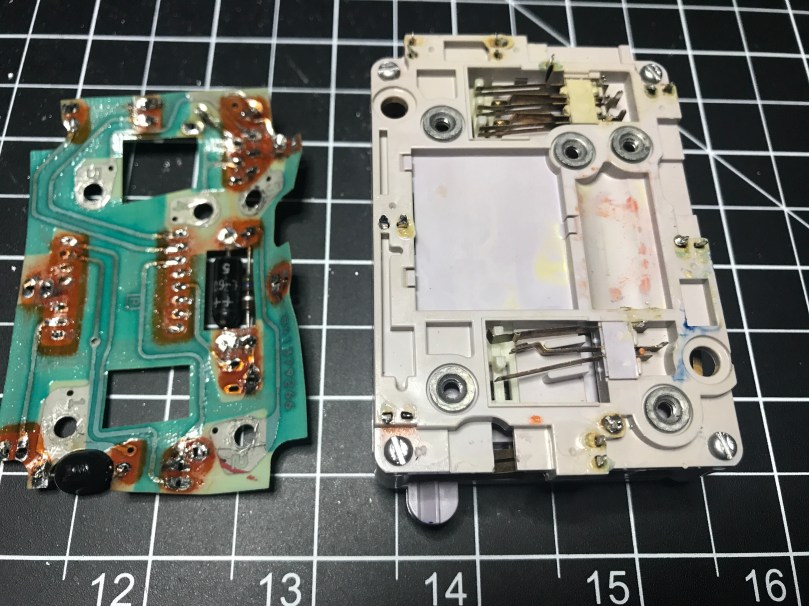
Go back and read Part 1 if you want to the full story on this little project. I did decide to get rid of the PCB on the old phone keypad. Good thing I’ve been getting a lot of desoldering practice. In order to remove the PCB, I first had to remove the wires I had added to the column and row contact points. That was easy and getting the PCB off was a pretty smooth process as well.
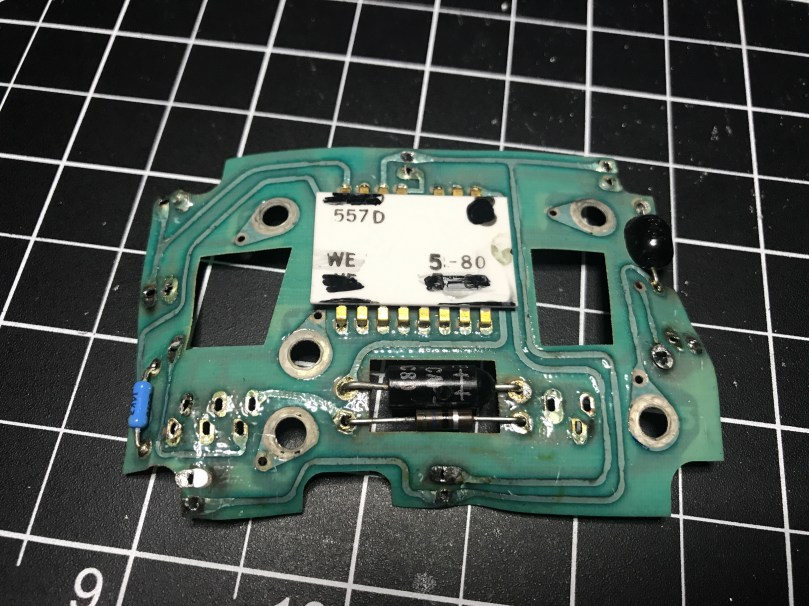
PCB and new look of the back side of the keypad.Other side of the PCB. The white rectangle is the back of the 557D IC.
Now that I didn’t have the PCB to carry power and ground around everywhere, I had to solder in my own wires. I also had to solder back in all of my connection points to provide the outputs I’d feed into a microcontroller (I used an Adafruit Feather 32u4 Basic Proto).
Once all of the wires were in place and then connected to my microcontroller I wasn’t getting expected results from a simple little program I wrote to display the values. Took far too long for me to remember I needed to use pull down resistors to prevent floating values. I put 10k Ω resistors in each of the circuits…
Prototyping with pull down resistors.
Output from the pins couldn’t get any better…
I loaded an example from the Arduino KeyPad library, which gave me very weird behavior. After looking at the underlying code, I realized it wanted the outputs of the keypad to be HIGH when a key was not pressed and LOW when it was. Well, my circuit was doing the opposite, so I had to have to invert everything. I didn’t have any inverter ICs, so I used NPN transistors to create an inverter circuit on each output.
Prototyping by inverting the output of the keypad column and row values.
Progress. Now I was able to get the library to correctly recognize some key presses. 95% of the time it seemed to think everything was coming from column 1 (1, 4, 7, *) though. The library comes with a MultiKey example. When I ran that, it was reporting every key on the row as being pressed. WTF?!
For the life of me I could not figure out what caused this. I checked wires, measured voltages, did continuity tests, resoldered connections, changed boards, used different GPIO pins, and countless other things. Nothing made a difference. My own code was working beautifully though. Eventually I gave up on the library. It wasn’t worth the effort and I was out of ideas.
Update: Later on I went back and read the KeyPad library code again because it was bugging me. Turns out these keypads don’t actively read the column pins like they do the row pins. My assumptions about how they worked was very wrong because I hadn’t read far enough into the code before. When checking for key presses, typical keypads iterate through the columns to send a pulse which feeds over in to the rows, which are then read in. How a Key Matrix Works has a pretty good explanation with visuals. If I get my hands on another similar keypad maybe I’ll try to recreate this functionality.
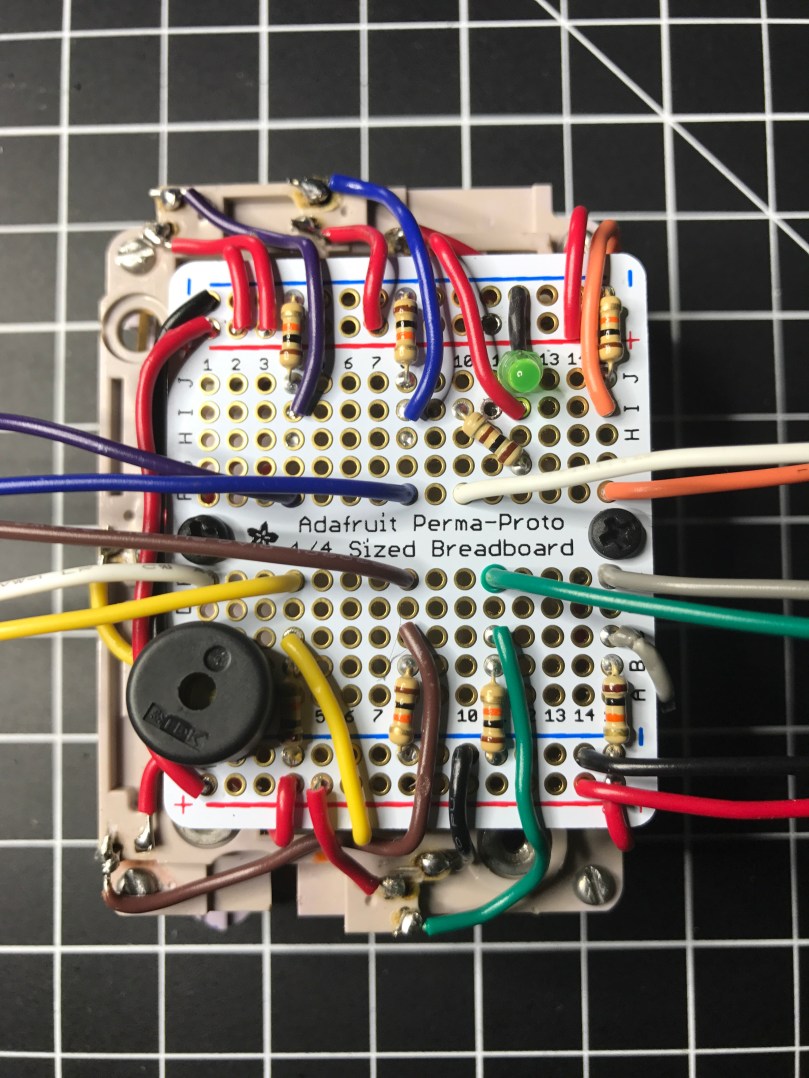
I rewired everything to use the pull down resistors again (video of soldering). A huge benefit of the decision was it drastically simplified my circuitry. This would save me 49 solder points! I probably would have needed to use a half-size perma-proto board instead of the 1/4 size I ended up using.
I decided to put in a piezo buzzer to add sounds. I also used a tiny LED, which I had salvaged from some old computer speakers, to show when power is switched on to the backlight.
The finished board. Isn’t it a thing of beauty?
Side view before bending the output wires off to the sides.
I tried a couple of different methods of producing touch tones (DTMF) to match up with each key, but with the microcontroller I’m using and the small piezo buzzer, the sound was terrible. I would need something a little more capable I think.
Here’s a demo video.
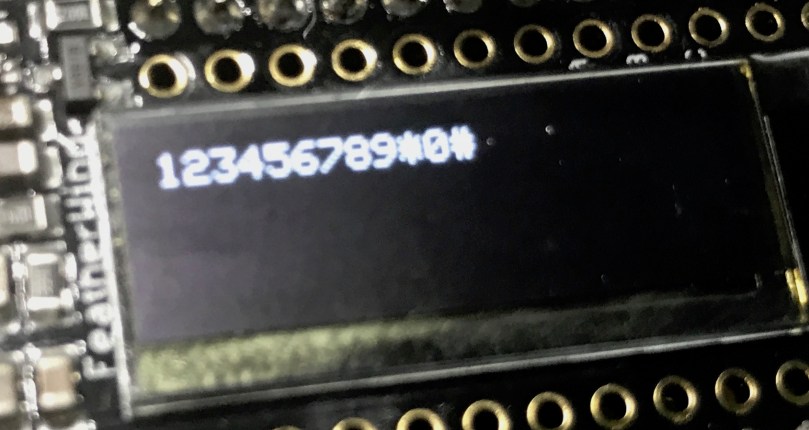
Hard to see the OLED screen in the video, but I was only using it to output each key press. Something like this…
I even went out of my comfort zone and did a quick share of this on Adafruit’s Show and Tell. If the video doesn’t start at the right spot you can skip ahead to the 12:42 mark. Going back to watch, my demo kind of sucked since it’s hard to hold something up to the Mac camera and push buttons at the same time.
Update: Continue on to Part 3, where I create a matrix of buttons to act as a keypad.
The woman working the register said she had just put them out and there was actually a 3rd copy that was coming apart so she was going to glue it back together.
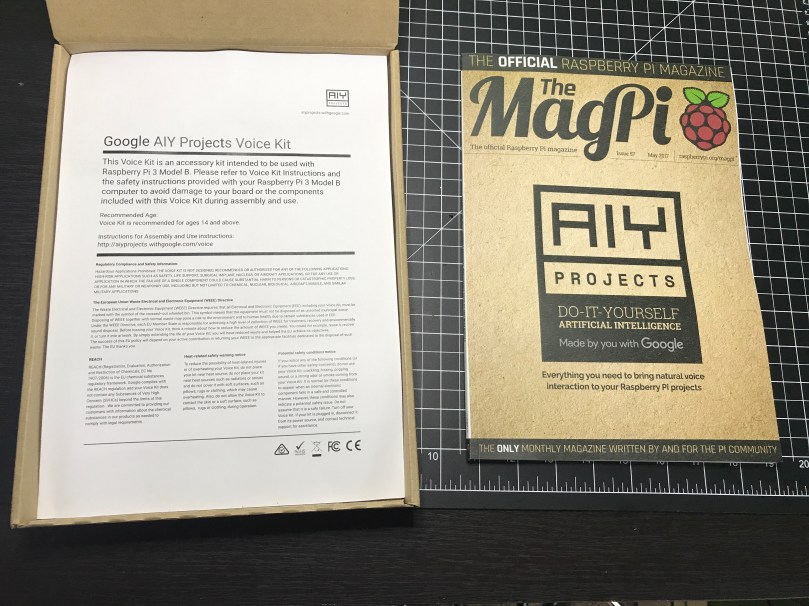
At $15 for a magazine, I don’t think you can really call this a “free” kit, but it’s still a good value. I don’t think I’ve ever “unboxed” a magazine before…
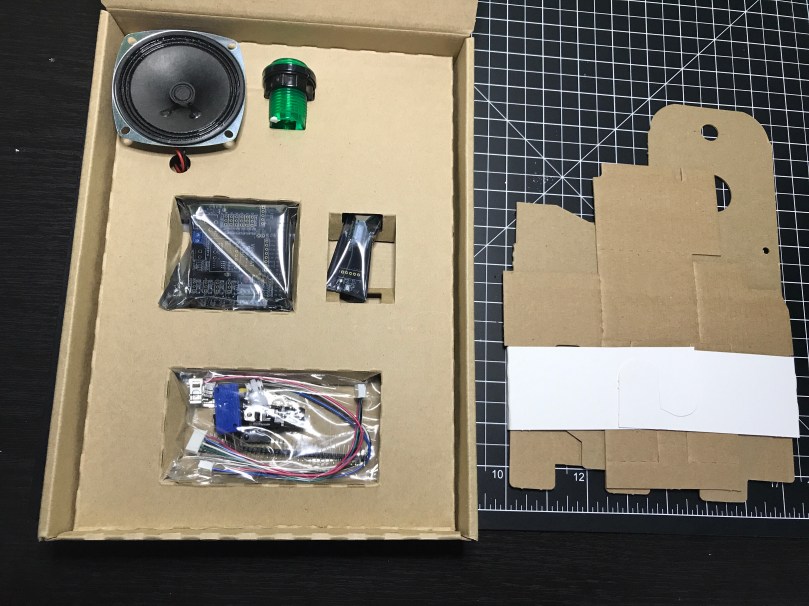
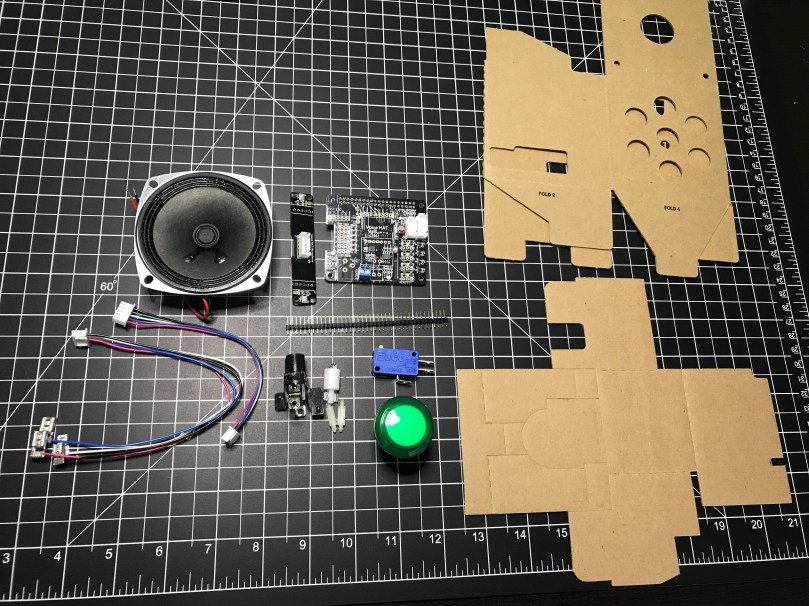
I love the emphasis on the maker here. Google is in this together with us.The actual magazine is the first thing you see when you open the box.A sheet with the typical warnings and instructions.The fun stuff! Various electronics parts and cardboard pieces to make a case.I guess the kits come with either a green, yellow, red or blue button.
This will be neat to mess around with. I’ve thought about turning one of my Pis into an Alexa type device to put in my office or bedroom and could easily do it now. If you have any project ideas involving voice, let me know.
Electronics Engineering ToolKit is a useful iOS app if you’re messing around with electronics. I think I paid $6.99 to upgrade to Pro, which unlocks all of the formulas, reference material, and tools.
My favorites in the app
I recently posted Using a 555 Integrated Circuit. There are many ways to use these 555s. To get a sense of the power of this app, it has 10 tools in its 555 Timer IC group! Here’s a look at the Monostable operation mode. Each tool in the app has a great info panel like this one, describing what it does.
The tool itself gives 2 inputs where you set your resistor and capacitor values and it calculates the time for you.
It provides a circuit schematic where the R (resistor) & C (capacitor) values are updated instantly, based on you input values. This schematic doubles as a simulation, where it really gets cool. You can tap on the button to see how the circuit reacts. In this case, the LED turns green (ON) for 2.42 seconds and then turns off.
I wired up the circuit to try it for myself. Worked exactly as expected. I even triggered my live circuit and the simulation at the same time and the LEDs turned off simultaneously.
This is just one example of many useful things you can do in the Electronics Engineering ToolKit app, especially with the Pro upgrade. Not only can you favorite (as shown at the beginning of this post) the tools you find most useful, but the app also has a great search feature.
You can find similar tools for specific formulas and uses around the Internet, but I haven’t come across anything where it’s all in one place with an easy to use interface like this. Perhaps the best web site I’ve found is Basic Electronics Tutorials and Revision, which is a bit higher level in the way their descriptions.
I’ve been on a kick tearing apart electronics. In addition to the switch I got a bunch of parts from, I’ve tore into a lamp and some old computer speakers. When I found an old telephone (it has a date of 5/30/1980 printed on it!) in my basement I knew I had to see what was inside. The previous owners left it in a storage room and I have no idea why I never pitched it. I didn’t take a picture before taking a screwdriver to it, but it looked exactly like the photo on the right.
People have been hacking phones for a long time. Perhaps the earliest and most well-known was the Steves (Jobs and Wozniak) using a blue box on payphones. I’m nowhere near that level, but you have to start somewhere right? I pulled the ringer, speaker, and microphone out of it. I haven’t messed with these yet.
A lot of parts were extremely dirty.
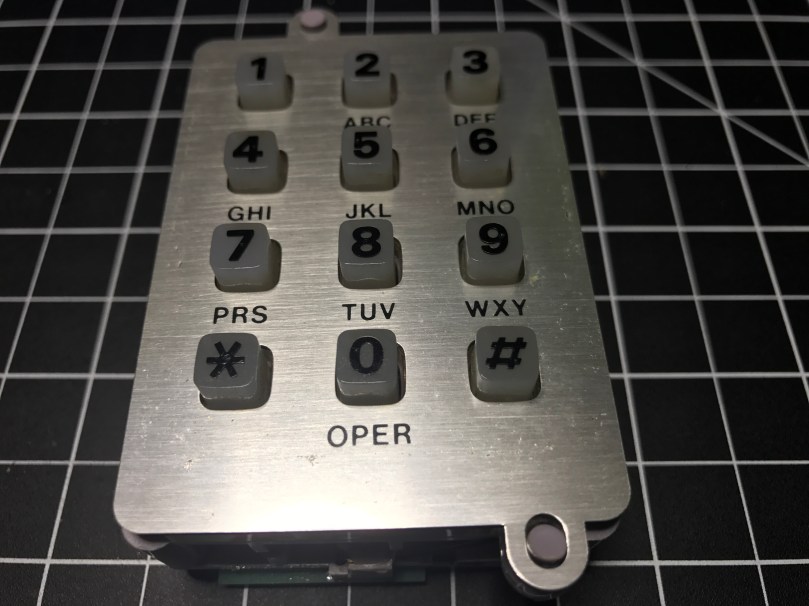
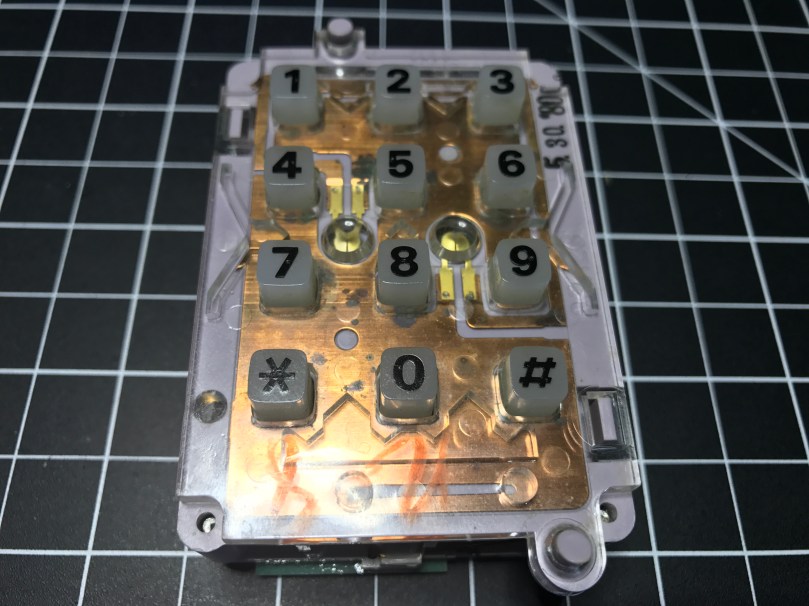
The part I thought would be neat to work with was this keypad.
With the faceplate removed you can see the date stamp in the upper right.Back side.
It was a bit of a process figuring out how to tap into this thing. Eventually I realized what these contact switches on the sides were for.
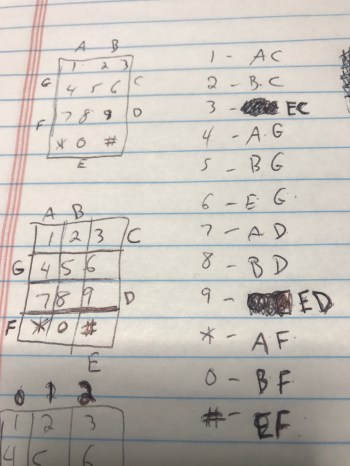
There are seven of them. The top has two and the bottom has one, which correspond to the 3 columns of keys on the grid. Then the left and right sides each have 2, which match up with the 4 rows of keys.
I figured out I could solder wires to the contacts points connected to each of those switches. I was in! From the way the keypad was connected to the rest of the phones circuitry I knew the screws were an important piece to tie it all back into the entire system. After some trial and error I determined which screws should be used for power (red wire) and ground (black) in order to get useable data out of the 7 switch contact points. The other 3 screws also connect to power. I was using alligator clips on those, but disconnected them for the picture.
Something isn’t quite right about the screw connections though. When I connect them the opposite way, flopping to have 1 power and 4 grounds, the backlight on the keypad works, but the readings from the soldered contact points are useless. With them connected this way, I don’t get the backlight, but I get data I can make sense of. There is probably something obvious I’m missing about how this all works together.
Unfortunately for me, the output from the contact points isn’t digital (limited to on/off), so I couldn’t use the Arduino library. It would have made things so much easier. It’s not surprising though, since this piece of technology is almost 40 years old!
I was able to get some code mostly working. Detecting the column of a button press was pretty straight forward and works great. Rows detection is another story. I’m reading in analog values and using sampling along with standard deviations to determine which row’s value is unlike the others. Well, the first row always reads a pretty high value, when a key on any row is pressed. The values for the other rows fluctuate as expected. When that first row is high, I’ve attempted to also look for a high value from another row, but it triggers the wrong row too often.
Demo time…
Even making this short little video, which took at least 5 takes, there was a false trigger for pressing 1 and many key presses not being recognized. Not useable.
I have a hunch the screw connections are responsible, at least in some part, for sending DTMF signals, also known as Touch-Tone. I don’t really care to get in the business of decoding these. This is precisely why I was hoping I could detect useful output from each of the row and column contact points.
I pulled apart the unit even more and discovered a Western Electric 557D is the brains of the operation, but it’s so old there doesn’t seem to be a datasheet online for it. What I’m going to do is remove the PCB and wire up everything on my own. Then I can easily get on/off as digital values from the columns and rows and make sure the backlight works. Stay tuned…
The battery (CR2450) in my garage door sensor was getting low, so I replaced it. I’ll keep the old one in my electronics kit for LED testing, as shown in this video. Touch the longer leg (anode) of the LED to + and the shorter leg (cathode) to –. Usually + is the top of the battery where the words are. Don’t worry, you won’t hurt the LED if you connect it the wrong way.











 I’ve been on a kick tearing apart electronics. In addition to


 There are seven of them. The top has two and the bottom has one, which correspond to the 3 columns of keys on the grid. Then the left and right sides each have 2, which match up with the 4 rows of keys.
 Nick Momrik